
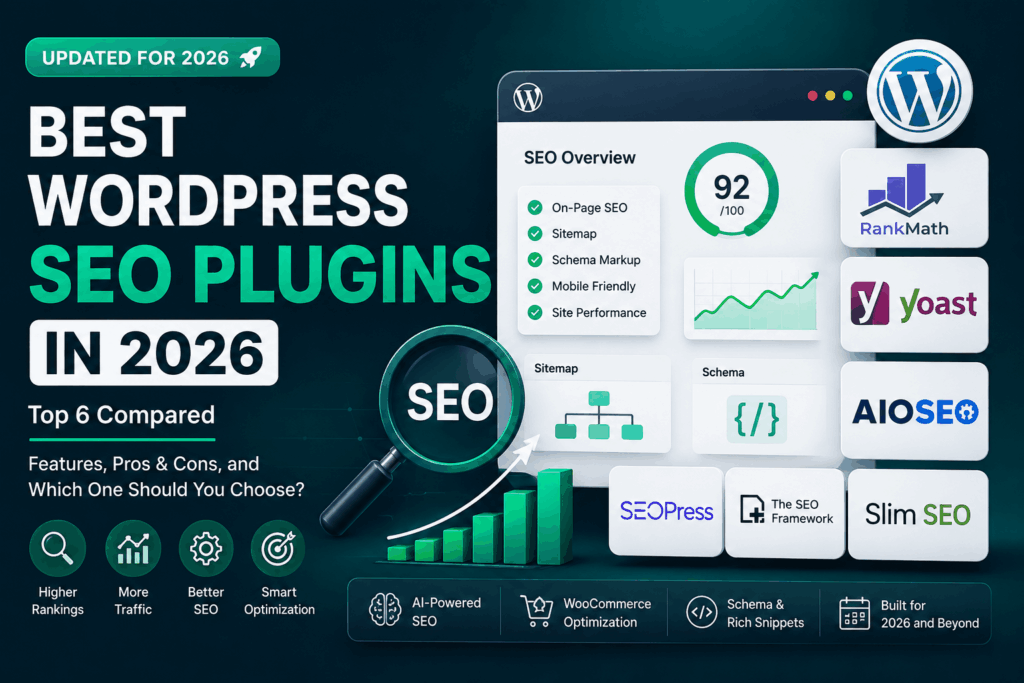
Search engine optimization (SEO) continues to evolve rapidly. In 2026, website owners must optimize not only for traditional Google search results but also for AI-powered search experiences, including Google AI Overviews and conversational AI assistants.
While content quality remains the most important ranking factor, the right SEO plugin can simplify technical optimization, improve structured data, manage sitemaps, optimize WooCommerce products, and help your website perform better in search engines.
In this guide, we’ll compare the best WordPress SEO plugins available in 2026 and help you choose the right one for your website.
1. Rank Math SEO ⭐ Editor’s Choice
Rank Math has established itself as one of the most feature-rich SEO plugins for WordPress. Its generous free version and powerful premium features make it an excellent choice for bloggers, businesses, agencies, and WooCommerce store owners.
Key Features
- Unlimited focus keywords
- AI-powered Content Assistant
- Advanced Schema Generator
- XML Sitemap
- Image SEO
- WooCommerce SEO
- Local SEO
- 404 Monitor
- Redirect Manager
- Google Search Console integration
- Google Analytics integration
- Instant Indexing support
- Rich Snippets
Pros
- Excellent free version
- Modern user interface
- Fast performance
- Powerful schema support
- Great WooCommerce integration
- Built-in redirection manager
Cons
- Beginners may find the number of options overwhelming.
- Some advanced AI tools require a Pro subscription.
Best For: WooCommerce stores, agencies, bloggers, and growing businesses.
2. Yoast SEO
Yoast SEO remains one of the most trusted SEO plugins. It is especially popular among bloggers and beginners due to its easy-to-understand content analysis.
Key Features
- Readability analysis
- SEO score
- XML Sitemap
- Canonical URLs
- Breadcrumbs
- Internal linking suggestions (Premium)
- Schema support
Pros
- Easy setup
- Beginner-friendly
- Excellent documentation
- Reliable updates
Cons
- Many advanced features require Premium.
- Limited free features compared to competitors.
Best For: Bloggers and beginners.
3. All in One SEO (AIOSEO)
AIOSEO offers an excellent balance between ease of use and advanced functionality. It includes smart automation, schema tools, and WooCommerce optimization.
Key Features
- SEO Audit Checklist
- XML Sitemap
- Local SEO
- WooCommerce SEO
- Smart Schema
- Link Assistant
- Redirection Manager
Pros
- User-friendly dashboard
- Great automation
- Strong WooCommerce support
Cons
- Some premium tools require a paid plan.
Best For: Small businesses and eCommerce websites.
4. SEOPress
SEOPress is a lightweight yet powerful SEO plugin popular among developers and agencies.
Key Features
- White-label support
- XML & HTML Sitemaps
- WooCommerce SEO
- Google Analytics integration
- Structured Data
- Redirect Manager
Pros
- Clean interface
- Affordable Pro pricing
- Developer-friendly
Cons
- Fewer beginner tutorials than Yoast.
Best For: Agencies and freelancers.
5. The SEO Framework
The SEO Framework focuses on speed and simplicity. It avoids unnecessary notifications and advertisements while delivering excellent SEO functionality.
Key Features
- Automatic meta tags
- XML Sitemap
- Local SEO extension
- Schema support
- Fast performance
Pros
- Extremely lightweight
- No ads
- Excellent performance
Cons
- Fewer marketing features.
- Smaller ecosystem.
Best For: Developers and performance-focused websites.
6. Slim SEO
Slim SEO is designed for users who prefer a “set it and forget it” SEO solution.
Key Features
- Automatic meta tags
- XML Sitemap
- Schema
- Redirects
- Breadcrumbs
Pros
- Very lightweight
- Minimal configuration
- Excellent performance
Cons
- Limited customization options.
Best For: Personal blogs and simple business websites.
Comparison Table
| Plugin | Free Features | WooCommerce SEO | Schema | Redirect Manager | Beginner Friendly |
|---|---|---|---|---|---|
| Rank Math | ⭐⭐⭐⭐⭐ | ✅ | Advanced | ✅ | ⭐⭐⭐⭐ |
| Yoast SEO | ⭐⭐⭐⭐ | Premium | Good | Premium | ⭐⭐⭐⭐⭐ |
| AIOSEO | ⭐⭐⭐⭐ | ✅ | Advanced | ✅ | ⭐⭐⭐⭐ |
| SEOPress | ⭐⭐⭐⭐ | ✅ | Advanced | ✅ | ⭐⭐⭐ |
| SEO Framework | ⭐⭐⭐ | Extension | Basic | Extension | ⭐⭐⭐⭐ |
| Slim SEO | ⭐⭐⭐ | Limited | Basic | Basic | ⭐⭐⭐⭐⭐ |
Which SEO Plugin Should You Choose?
Choose Rank Math if you:
- Run a WooCommerce store
- Need advanced schema
- Want AI-powered SEO tools
- Prefer an all-in-one SEO solution
Choose Yoast SEO if you:
- Are new to WordPress
- Focus primarily on blogging
- Want excellent readability guidance
Choose AIOSEO if you:
- Own a business website
- Need automation
- Want an intuitive interface
Choose SEOPress if you:
- Manage multiple client websites
- Need white-label functionality
- Want developer-friendly tools
Choose The SEO Framework if you:
- Prioritize website speed
- Prefer a lightweight plugin
- Want minimal distractions
Choose Slim SEO if you:
- Need a simple SEO setup
- Don’t want to spend time configuring settings
SEO Trends in 2026
SEO is no longer just about ranking on Google. Modern websites should also optimize for AI-powered search experiences by focusing on:
- High-quality original content
- Structured data (Schema)
- Fast Core Web Vitals
- Internal linking
- Product schema for WooCommerce
- FAQ schema
- Entity-based optimization
- E-E-A-T (Experience, Expertise, Authoritativeness, and Trustworthiness)
The best SEO plugins now provide tools to support these practices, making it easier to prepare your website for both traditional search engines and AI-driven discovery.
Final Verdict
If you’re looking for the best all-around SEO plugin in 2026, Rank Math stands out as the top choice. Its generous free features, excellent WooCommerce integration, advanced schema capabilities, and AI-powered tools make it a compelling option for most WordPress users.
However, Yoast SEO, AIOSEO, SEOPress, The SEO Framework, and Slim SEO each serve different audiences and remain excellent choices depending on your specific needs.
No matter which plugin you choose, remember that successful SEO depends on consistent content creation, technical optimization, user experience, and ongoing performance monitoring—not just installing a plugin.
Helpful Links
- Rank Math SEO — https://wordpress.org/plugins/seo-by-rank-math/
- Yoast SEO — https://wordpress.org/plugins/wordpress-seo/
- All in One SEO — https://wordpress.org/plugins/all-in-one-seo-pack/
- SEOPress — https://wordpress.org/plugins/wp-seopress/
- The SEO Framework — https://wordpress.org/plugins/autodescription/
- Slim SEO — https://wordpress.org/plugins/slim-seo/