
A few years ago, being a good programmer meant knowing how to write code efficiently. You needed to understand programming languages, frameworks, databases, algorithms, debugging, architecture, and deployment.
Today, things are changing quickly.
Powerful AI coding models can generate Laravel applications, WordPress plugins, React components, SQL queries, APIs, tests, documentation, and even entire features in minutes.
So a natural question is:
If almost every developer has access to a powerful AI coding model, what will make one developer better than another?
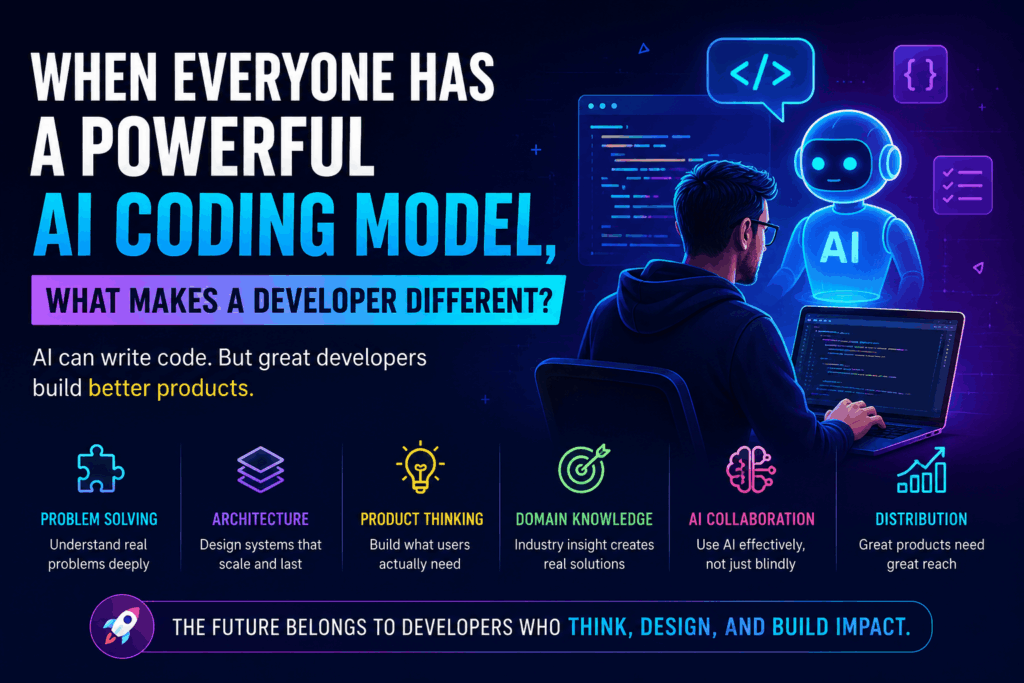
The answer is simple: coding itself is becoming less of a competitive advantage.
The advantage is moving toward engineering judgment, product thinking, domain knowledge, and the ability to use AI effectively.
AI Is Making Coding More Accessible
AI has dramatically reduced the amount of time required to turn an idea into working code.
A developer can describe a requirement such as:
“Create a WordPress support ticket system with customer registration, ticket creation, email notifications, attachments, agent assignment, and a dashboard.”
An AI coding model can generate a significant portion of the initial implementation.
The same thing applies to almost every modern technology stack.
AI can help developers:
- Generate boilerplate code
- Build API endpoints
- Create database migrations
- Write SQL queries
- Generate frontend components
- Create WordPress plugins
- Build Laravel applications
- Write automated tests
- Find bugs
- Explain unfamiliar code
- Refactor existing code
- Generate documentation
This means the barrier to producing software is becoming much lower.
But there is an important distinction:
Generating code is not the same as building good software.
If Everyone Uses AI, AI Alone Isn’t the Advantage
Imagine 100 developers have access to the same powerful coding model.
Developer A asks:
“Build me a SaaS application.”
Developer B asks:
“Build a multi-tenant SaaS platform with organizations, role-based permissions, subscription lifecycle management, usage limits, audit logs, webhook processing, retry handling, and tenant-level data isolation.”
Both developers are using AI.
But they aren’t using it at the same level.
The second developer understands the problem much better.
This is where the competitive advantage begins to shift.
The Future Developer Needs Better Judgment
AI can generate thousands of lines of code.
But who decides whether those thousands of lines should exist?
The developer.
AI can suggest an architecture.
But who decides whether that architecture will survive three years of growth?
The developer.
AI can generate a database schema.
But who understands the business rules that the schema needs to support?
The developer.
This is why experienced developers aren’t necessarily becoming less valuable.
Instead, their role is changing.
They are moving from:
“I write the code.”
toward:
“I design the system and direct the machine that writes much of the code.”
Architecture Becomes More Important
When writing code manually, developers naturally think carefully about how much code they can realistically maintain.
When AI can generate code extremely quickly, there is a new danger:
software can become complicated extremely quickly.
You can ask AI to create another service, another abstraction, another database table, another API endpoint, or another dependency.
And suddenly you have a huge application that technically works but is difficult to maintain.
Understanding architecture becomes extremely important.
Developers need to understand concepts such as:
- Separation of concerns
- Database design
- Caching
- Queues
- Authentication
- Authorization
- Scalability
- API design
- Security
- Observability
- Performance
- Failure handling
- Data consistency
AI can help implement these concepts.
But someone still needs to make the decisions.
Debugging Will Still Matter
One of the biggest misconceptions about AI coding is that generated code is always correct.
It isn’t.
AI can produce code that:
- Looks correct but fails in production
- Has subtle security vulnerabilities
- Creates inefficient database queries
- Breaks under high traffic
- Handles edge cases incorrectly
- Uses outdated APIs
- Introduces unnecessary complexity
An experienced developer can often identify these problems quickly.
That means debugging knowledge becomes even more valuable.
The developer who understands why something works will have an advantage over someone who only knows how to ask AI to make something work.
Product Thinking May Become More Valuable Than Coding
This may be the biggest change.
Suppose two developers can both build a WordPress plugin in a few days because AI handles much of the implementation.
What separates them?
The first developer builds another generic plugin.
The second developer talks to customers and discovers that WooCommerce store owners are struggling with abandoned carts, customer follow-ups, and sales automation.
The second developer builds a product around that problem.
Both can code.
But only one found a valuable problem.
This is why product thinking becomes increasingly important in an AI-powered development world.
Domain Knowledge Becomes a Superpower
AI knows a tremendous amount about software.
But developers who understand a specific industry can give AI much better direction.
For example, a developer who deeply understands:
- WordPress
- WooCommerce
- Payment systems
- Subscription billing
- SEO
- Customer support
- E-commerce
- SaaS
can combine that knowledge with AI to create specialized products much faster.
Instead of asking:
“What can AI build?”
they can ask:
“What problem do businesses in this industry have that AI can help me solve?”
That is a much more powerful question.
Distribution Becomes More Important
There is another uncomfortable reality.
Building software is becoming easier.
Getting people to use it is not.
AI can help you build a product.
It cannot automatically guarantee:
- Customers
- Trust
- Brand recognition
- Distribution
- SEO authority
- Partnerships
- Community
- Customer relationships
If 10,000 developers can build similar products, the developer who knows how to reach customers may win.
This means software businesses increasingly need both:
Product + Distribution
rather than simply:
Product = Code
The Best Developers May Become “AI Engineers”
The next generation of strong developers may not spend most of their day typing code.
Instead, they may spend their time:
- Understanding the problem
- Designing the architecture
- Breaking the problem into tasks
- Giving AI precise instructions
- Reviewing generated code
- Testing the implementation
- Finding edge cases
- Improving performance
- Deploying the system
- Monitoring real-world behavior
- Iterating based on user feedback
The keyboard is still important.
But thinking becomes more important than typing.
The Developer Advantage Is Moving Up the Stack
The software industry may increasingly look like this:
Old advantage:
Programming knowledge → coding speed → software
New advantage:
Problem understanding → architecture → AI orchestration → engineering judgment → product → distribution
AI is reducing the cost of the first part.
That means developers need to become stronger at the parts above it.
Does This Mean Junior Developers Will Become Less Important?
Possibly, especially for simple coding tasks.
If a task can be solved by asking an AI model to generate a standard CRUD application, companies may need fewer people doing only that type of work.
But this doesn’t mean junior developers have no future.
It means the learning path changes.
Instead of spending years only learning syntax, a new developer can use AI as a tutor and coding assistant while learning:
- How systems work
- How databases work
- How HTTP works
- How security works
- How applications scale
- How to test software
- How to read existing code
- How to reason about requirements
The goal shouldn’t be:
“I need to memorize everything AI can generate.”
The goal should be:
“I need to understand software well enough to know whether what AI generated is actually good.”
So What Will Separate Developers in the AI Era?
When everyone has access to powerful AI coding models, several skills become increasingly valuable.
1. Problem Solving
Can you understand a complicated problem and break it into smaller problems?
2. Architecture
Can you design a system that remains maintainable as it grows?
3. Product Sense
Can you identify problems that people actually care about?
4. Domain Knowledge
Do you understand a particular industry deeply?
5. AI Collaboration
Can you communicate requirements to AI clearly and efficiently?
6. Code Review
Can you recognize bad AI-generated code?
7. Testing
Can you prove that the software actually works?
8. Security
Can you identify vulnerabilities that AI accidentally introduced?
9. Deployment and Operations
Can you take software from a development environment into production?
10. Distribution
Can you get real users to discover and adopt what you built?
The Interesting Part: Small Teams Can Become Extremely Powerful
This may ultimately be the biggest consequence of AI-assisted programming.
A small team of two or three experienced developers may be able to build what previously required a much larger engineering team.
One person can work on the backend.
AI can help generate implementation.
Another person can work on the frontend.
AI can help with UI and integration.
A third person can focus on infrastructure, testing, product, and customers.
The result can be surprisingly powerful.
This doesn’t mean software engineering becomes unimportant.
It means the productivity of a good engineer can increase dramatically.
AI Doesn’t Remove the Need for Good Developers
Instead, it changes what “good developer” means.
The developer who wins in the future probably won’t be the person who can type PHP, JavaScript, Python, or Java the fastest.
It will be the person who can combine:
Technical knowledge + AI + product thinking + business understanding + execution.
Coding is becoming a commodity.
Good judgment is not.
And that may be the real competitive advantage in the age of AI-powered software development.